
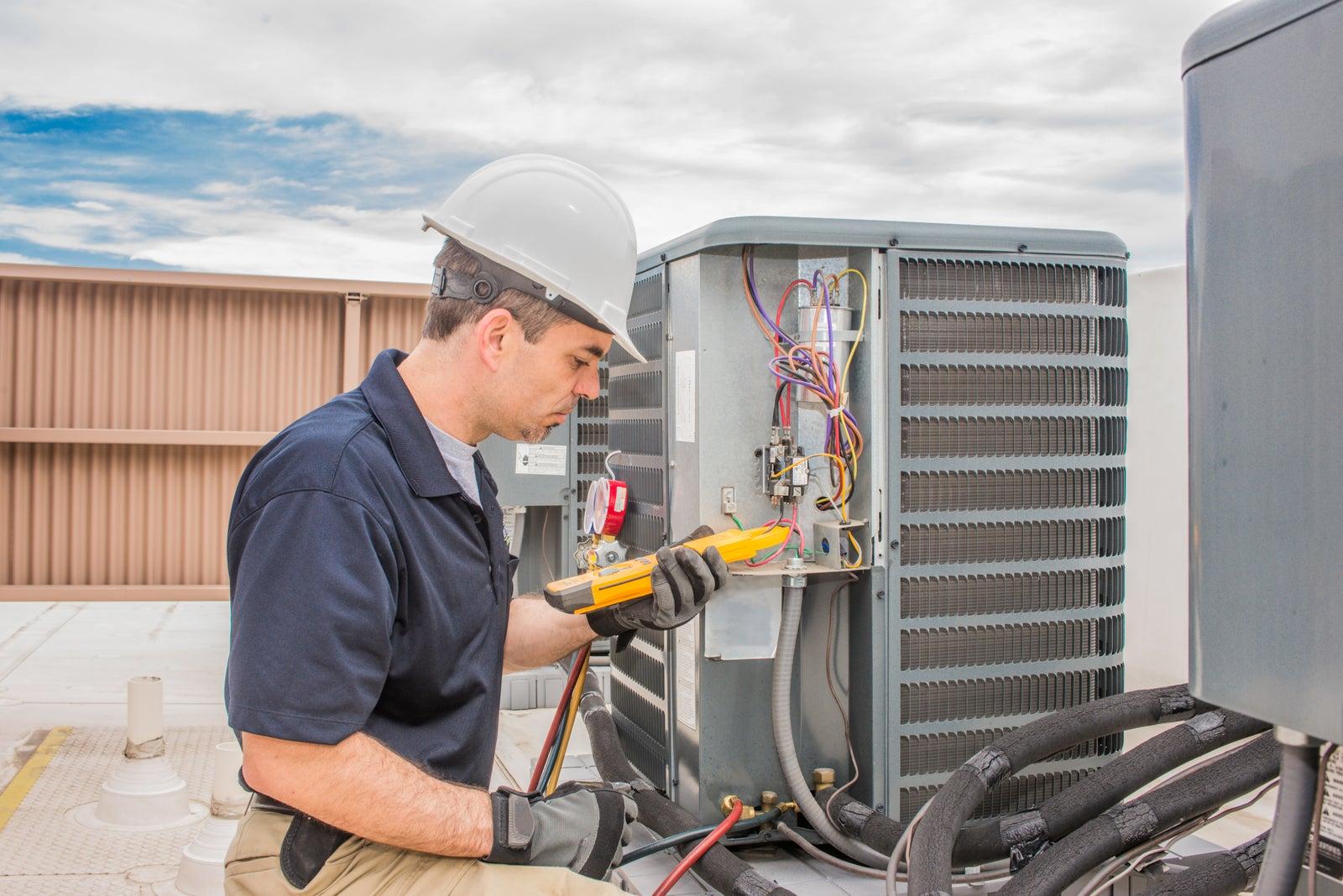
Quick answer: An AC condenser is the outdoor unit of a central air conditioner or heat pump. It houses the compressor, condenser coil, and fan, and its job is to release the heat your system removes from inside your home. Warm air, loud noises, and short cycling are common signs of trouble. Many problems, like a failed capacitor or dirty coil, are repairable, but an aging unit with a failed compressor usually needs replacing.
On this page:
What is an AC condenser?
How it works
What’s inside
Types of condensers
When a condenser goes bad
What to check first
Florida’s climate
Repair or replace
What it costs
Maintenance
FAQs
The metal box humming outside your home does the hardest work in your cooling system. This guide explains what an AC condenser is, how it works, what happens when it goes bad, and when to choose repair or replacement. (It covers home central air, not car AC.)
If your system is blowing warm air right now, Sansone Air Conditioning & Plumbing offers same-day AC repair in Haverhill, Port St. Lucie, and surrounding communities. Call 561‑406‑4410.
What Is an AC Condenser?
An AC condenser, also called an air conditioner condenser or outdoor unit, is the part of a central air conditioner or heat pump that sits outside your home. It contains the compressor, the condenser coil, and a large fan. Its job is to release the heat your system pulls out of your living space into the outdoor air.
How Does an AC Condenser Work?
An AC condenser turns hot, high-pressure refrigerant gas back into a liquid so it can return indoors and absorb more heat:
Warm refrigerant arrives. Refrigerant carrying heat from your home travels to the outdoor unit as a low-pressure gas.
The compressor pressurizes it, raising its temperature above the outdoor air.
The coil and fan release the heat. The fan pulls outdoor air across the coil’s thin aluminum fins and pushes the heat out the top of the unit.
The refrigerant condenses and returns to the indoor coil as a liquid to start the cycle again.
What’s Inside an AC Condenser Unit?
Component | What it does | Common problem |
|---|---|---|
Compressor | Pressurizes refrigerant and pumps it through the system | Wear or failure, most often on older units |
Condenser coil and fins | Release heat into the outdoor air | Dirt, bent fins, corrosion, leaks |
Condenser fan and motor | Pull outdoor air across the coil | Motor failure; fan stops spinning |
Capacitor | Gives the compressor and fan motor a burst of power to start | Weakens with heat and age; a very common repair |
Contactor | Switch that turns the unit on when the thermostat calls for cooling | Worn contacts; unit won’t start or won’t stop |
Refrigerant lines | Carry refrigerant between the indoor and outdoor units | Leaks, damaged insulation |
Condenser vs. Compressor vs. Evaporator Coil: What’s the Difference?
“Condenser” and “compressor” often get used interchangeably, but the compressor is a pump inside the condenser unit.
Part | Where it is | What it does |
|---|---|---|
Condenser (outdoor unit) | Outside your home | Releases heat into the outdoor air |
Compressor | Inside the condenser unit | Pressurizes and moves refrigerant |
Evaporator coil | Indoors, at the air handler | Absorbs heat and moisture from your home’s air |
Types of AC Condensers
Central Air Conditioner Condensers
The most common setup: a split system pairing an outdoor condenser with an indoor air handler and evaporator coil. It provides cooling only.
Heat Pump Outdoor Units
A heat pump’s outdoor unit looks almost identical to an AC condenser, but it can reverse the refrigerant cycle to heat your home on cool days. Learn about Sansone’s heat pump and ductless systems.
Ductless Mini-Split Outdoor Units
Mini-splits use a smaller outdoor unit that serves indoor units without ductwork. Packaged units, by contrast, hold every component in one outdoor cabinet.
Single-Stage, Two-Stage, and Variable-Speed Models
Single-stage condensers run at full power whenever they’re on and cost the least upfront.
Two-stage condensers have a low setting for milder weather.
Variable-speed condensers adjust output in small steps, which improves humidity control and efficiency.
Efficiency is rated by SEER2 (Seasonal Energy Efficiency Ratio 2). A higher SEER2 number means lower operating costs.
What Happens When an AC Condenser Goes Bad?
When an AC condenser goes bad, it can’t release heat from the refrigerant, so your system blows warm or weak air, runs longer, and uses more electricity. Depending on the cause, you may hear grinding or buzzing, see the fan stop spinning, or notice the unit cycling on and off. Left alone, the extra strain can damage the compressor.
Signs of a Bad AC Condenser
Warm or weak air from your vents
The outdoor unit hums, but the fan isn’t spinning
Grinding, banging, rattling, or loud buzzing
Short cycling: the system turns on and off without reaching the set temperature
Ice on the refrigerant lines or oily residue, possible signs of a refrigerant leak
Rising energy bills with no change in use
Visible corrosion, bent fins, or damage
Noticing any of these signs? Sansone offers same-day AC repair with no extra fee for emergency, evening, or weekend service. Call 561‑406‑4410.
Common AC Condenser Problems and What Causes Them
What you notice | Likely cause | DIY or pro? | Urgency |
|---|---|---|---|
Fan not spinning, unit humming | Failed capacitor or fan motor | Pro | High |
Outdoor unit won’t turn on | Tripped breaker, thermostat setting, failed contactor | Check breaker and thermostat, then pro | Medium to high |
Unit runs, but air is warm | Dirty coil, refrigerant leak, failing compressor | Rinse coil (DIY), then pro | Medium to high |
Ice on refrigerant lines | Low refrigerant or restricted airflow (often a dirty filter) | Change filter, then pro | High |
Grinding or squealing | Worn fan motor or failing compressor | Pro | High |
Short cycling | Dirty coil, electrical issue, wrong-size system | Pro | Medium |
Corroded or bent fins | Salt air, debris, lawn equipment | Pro | Low to medium |
What to Check Before You Call a Technician
Check the thermostat. Make sure it’s set to Cool and below room temperature, with fresh batteries.
Check the breaker. Reset a tripped AC breaker once. If it trips again, leave it off and call for service.
Replace a dirty air filter. According to the U.S. Department of Energy, a clean filter can lower an air conditioner’s energy use by 5% to 15%.
Clear the area. Trim foliage back at least 2 feet from the condenser.
Safety note: Never open the cabinet or touch electrical parts. The capacitor can hold a dangerous charge even with the power off. Before any cleaning, shut off power at the outdoor disconnect and the breaker.
How Florida’s Climate Affects Your AC Condenser
In South Florida, a long cooling season and high humidity mean more run hours and more wear on the compressor, fan motor, and capacitor. If your home still feels sticky, Sansone’s indoor air quality team can help.
Salt Air and Coastal Corrosion
Near the coast, salt speeds up coil corrosion, which can cause refrigerant leaks and shorten the unit’s life. Rinse the coil with fresh water, schedule regular inspections, and ask about coated coils when replacing.
Protecting Your Condenser During Hurricane Season
Before the storm: Secure patio furniture and yard items that could become debris, and trim weak branches near the unit.
During the storm: Turn the system off at the thermostat and breaker to protect it from power surges.
After the storm: Check for debris and damage before restarting. If the unit was underwater, don’t run it; FEMA advises having water-exposed mechanical equipment inspected by a qualified professional.
Plan for outages: A properly sized backup generator can keep your AC running when the power goes out.
AC Condenser Repair or Replacement: How to Decide
Capacitors, contactors, and fan motors are usually simple fixes; a failed compressor or leaking coil on an older system often isn’t. Talk with a technician about AC condenser repair or AC replacement.
Repair makes sense when… | Replace makes sense when… |
|---|---|
Your system is relatively new and reliable | Your system is nearing the end of its expected lifespan (about 5 to 7 years for coastal condensers, or around 10 to 15 years inland) |
The problem is a capacitor, contactor, fan motor, or dirty coil | The compressor has failed or the coil is leaking |
This is the first major problem | You’ve needed repeated repairs |
Energy bills and comfort are steady | Energy bills keep climbing and comfort keeps slipping |
Your refrigerant is still serviced | Your system uses R-22, a phased-out refrigerant |
Not sure which way to go? Sansone offers free HVAC estimates, plus free second opinions if another company has recommended replacement.
Can You Replace Only the Condenser?
Sometimes. Your condenser and indoor coil are designed as a matched pair, and mismatched equipment can hurt efficiency and affect warranty coverage.
Refrigerant rules matter too. Under the EPA’s Technology Transitions rule, new residential systems made since January 1, 2025, use lower-impact refrigerants such as R-454B and R-32 instead of R-410A. A 2026 final rule lets contractors keep installing pre-2025 R-410A equipment until supplies run out, and existing R-410A systems can still be serviced. A technician will check what’s compatible with your existing coil before recommending a condenser-only replacement.
How to Maintain Your AC Condenser
Keep it clear. Trim plants back 2 feet and keep leaves, lawn clippings, and dryer vent lint away from the unit.
Change your air filter every month or two during the cooling season. In South Florida, that’s most of the year.
Schedule professional maintenance at least once a year, before the hottest months. A technician should check refrigerant, test for leaks, tighten electrical connections, and verify thermostat accuracy.
Sansone’s AC maintenance service covers these checks.
Condenser Coil Cleaning: What You Can Do and What to Leave to a Pro
What you can do: Shut off power at the disconnect and breaker, clear debris by hand, and gently rinse the fins from the outside with a garden hose. Never use a pressure washer; it can flatten the fins.
Leave to a pro: Removing the fan assembly, chemical cleaning, straightening fins, and anything electrical or refrigerant-related.
Why Choose Sansone for AC Condenser Repair and Replacement
Since 1976, Sansone Air Conditioning & Plumbing has helped South Florida homeowners stay cool, earning thousands of five-star Google reviews. Our licensed technicians repair and replace AC condensers, heat pumps, and ductless systems.
We offer same-day AC service, next-day installation, and free estimates and second opinions, with no extra fee for emergency, evening, or weekend service.
We Deliver Amazing Service. And when your condenser quits, We Deliver Cool. Call 561‑406‑4410 or schedule AC repair online.
We serve homeowners in Haverhill, West Palm Beach, Jupiter, Boca Raton, Fort Lauderdale and Port St. Lucie, plus surrounding communities across Southeast Florida.
AC Condenser FAQs
What does an AC condenser do?
It releases the heat your air conditioner removes from your home into the outdoor air, then sends cooled refrigerant back inside.
Is the AC condenser the same as the compressor?
The compressor is a pump inside the condenser. The condenser is the whole outdoor unit, including the compressor, coil, and fan.
How long does an AC condenser last in Florida?
Florida is tough on AC condensers. InterNACHI’s Florida life expectancy chart estimates condensers in coastal areas last about 5 to 7 years. Inland, systems typically last longer, often around 10 to 15 years with regular maintenance.
Can I replace just my AC condenser?
Sometimes, if the new unit is compatible with your indoor coil and refrigerant. A technician should check first.
Why is my AC condenser fan not spinning?
Common causes are a failed capacitor, bad fan motor, worn contactor, or tripped breaker. If the unit hums but the fan won’t spin, turn it off to protect the compressor.
Why is my AC condenser running but not cooling?
A dirty coil, refrigerant leak, clogged air filter, or failing compressor is usually to blame. Change the filter, then call a technician.
Should I cover my AC condenser during a hurricane?
Never run the unit with a cover on, and avoid tight wraps that trap moisture. Secure loose items, turn the system off during the storm, and inspect it before restarting.
How often should my AC condenser be serviced?
Service your AC condenser at least once a year, ideally before the hottest months.
Related Articles
What do you need help with today?
Heating
No heat, strange smells, rising bills? We repair and replace heating systems to keep your home reliably warm.
Air Conditioning
AC blowing warm air? Uneven cooling in your rooms? We fix cooling issues fast and keep your system running smoothly all summer.
Plumbing
Our highly trained plumbers handle it all, from leaky faucets to full system installations and repipes.
Electrical
The smartest team in town. You need repair, installations, wiring, inspections, lighting — you name it.